


 +44 (0)1455 848 411


What is the QC process once the work is complete?
A key part of the rehousing process is the final quality control of the product. At TLS, we are obsessed with quality. This is something that is carried throughout the entire process. Adding this final stage to the process allows us to have trust and pride in our products that they’re to the best standard possible. As each lens is hand-crafted in the headquarters, at the centre of the UK, we know that there is always the possibility for human error during a build. Therefore, our QC checks are carried out by a team independent to the rehousing technicians.

Final stages of the process
Once the rehoused lens is engraved, painted and had the final assembly done, it returns to the original technician that built and marked up the lens (more can be found about this in the ‘rehousing process’ section of our website). This is to give the technician the opportunity to check over the lens and make sure they’re satisfied with the mechanical feel and operation. They will also assess the lens for cleanliness and optical performance along with checking back-focus and footage/T-scale accuracy. At this stage, the technician will prepare the final stages of the rehousing. The front and rear caps are cleaned and checked. Then the front and rear elements will have a final inspection (and clean if necessary) before the caps are placed on the lens. The externals of the lens are then cleaned and wiped to make sure there are no contaminants or fingerprint remaining. This completes the rehousing process, and the lens is ready of quality control.
The quality control team
To keep this process as independent as possible, the QC is done in a different department to the rehousing team. Therefore, the servicing team (who also perform the original assessments) will carry out the QC checks. The servicing team have over 25 years of experience across a varied range of cine and broadcast lenses. They benefit from working on a variety of lenses from rare vintage zooms through to the latest cine primes. The team members also engage with external training courses such as those that Cooke and Zeiss provide. Having the knowledge of such a vast variety of lenses, they’re able to use their experience to pick up on any slight defects that may be present in the final rehoused lens. Furthermore, they have the knowledge and understanding of the rehousing from servicing many of our own lenses. This experience allows them to pin-point any discrepancies to feedback to the rehousing technician, should they need to.
The quality control process
One the lens(es) arrive with QC, here is an overview of the process they go through:
- Make sure all paperwork is in the box (including scratch sheets and card).
- First check the external condition of the lens- looking out for any defects on the metal work, missing screws or components that may have not been painted.
- Secondly check the feel of the mechanical movements- make sure the focus bearing has a smooth and even movement throughout the range. The iris movement should also be smooth and consistent through its travel (listen for any potential noise caused by the mechanism e.g. rubbing/scraping).
- Check the optical condition of the lens- look out for any cleaning marks or fibres which may be present. At this point the scratch sheet of the lens should be used for reference.
- Look through the paperwork to see if additional work quoted for has been carried out e.g. de-yellowing/edge blacking or recementing.
- Check the image of the lens is within specification (centring is even and image looks to be as expected).
- If happy with the lens, then make sure the front and back glass is clean before re-fitting caps.
- Set the lens to infinity and fit the black rubber band around the focus gear.
- Sign the reference card once the lens has passed QC and take through to the office (once the full set has been completed).
- If any lenses fail the QC process, then record a detailed description of why, update the notes on the system and feed back to the rehousing management. The lenses will be checked by the rehousing management before passing back to relevant technician to correct if needed.
- The lens will then be passed back to QC to make sure the issue has been corrected, repeat the process to ensure it meets TLS` standards.
- Once satisfied, take the lenses through to the office team for packaging and shipping.
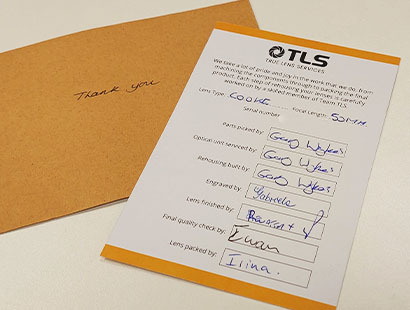
The team work closely together throughout this process. If one of the servicing team isn’t 100% satisfied with the condition of anything, they’ll seek a second opinion from a senior engineer or management. This gives the whole team and company the confidence that our rehoused lenses are the best they can be.
During the rehousing process, a job card will be assigned to each lens. This card has the main processes that are carried out once the rehousing process begins. As it passes through each stage, the technician that carries out the work will sign off what they’ve done. This card stays with the lens, even when it is returned to the customer. This not only shows the amount of work and skilled technicians that are involved in each stage of the process, but also allows the QC team to feedback to specific people if needed. Overall, the card invokes pride in the team. As each box is signed off, the technician knows they’ve carried out their part to the best of their abilities, but more importantly, to the standard of TLS!
If you would like to discuss this topic further or have any questions on the subject, please get in touch with us at sales@truelens.co.uk or calling our office on +44 (0)1455 848411.