


 +44 (0)1455 848 411


Can you rehouse any lens I send to you?
The short answer to this is, there’s a good possibility we can. As we’re essentially just taking the optical unit(s) and moving them in the same way they were designed to be, all we need to do is design and manufacture the new housing. This is possible for most lenses that are on the market today. However, that does not mean that we are able to offer a rehousing on every lens out there. Let’s investigate some of the reasons why this is not practical.
Design time
Even though the system we currently use for rehousing lenses is modular, each lens has its own design and unique components. From the exterior, most of our rehoused lenses look similar. For the most part they’re either 110mm or 95mm front diameter and range in length. However, this is where the similarities stop. Once you start to disassemble the lenses, you’ll find that the internal components on each lens are unique in nearly every scenario. The main reason for this is due to each optical design is different for every lens we rehouse. Even within different series or versions of the same range of lenses will pose different optical and mechanical designs. A good example of this is the original Cooke Speed Panchro lenses from 1930s-1960s. There are 3 series throughout the decades and within these series, some focal lengths had different variants too. Each one of these uses unique mechanical components internally. Therefore, once they’re rehoused, they look the same externally, internally they are all different. This means that, no matter what lens we’re designing to be rehoused, it must be a ‘ground up’ process. For us to be able to offer a competitive price on our services, doing one-off lenses would be uneconomic. When designing a rehousing that we know we’ll sell more than 20 of, the research and design time can be diluted across these sales. However, for a bespoke project, all the research and design cost would fall into the price of that one rehousing.
Manufacturing resource
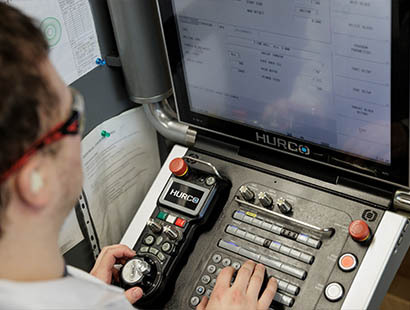
Let’s say you’re comfortable with covering all the research and design time cost for a one-off bespoke project. Now we need to look at the manufacturing implications. Once all the designs are in place and each component has been drawn up, we can begin to manufacture the parts. Due to the nature of the manufacturing process, it is not economical to make just one of each component. A large portion of the manufacturing time is usually in the programming and setting up of the CNC machines. However, if all the programming and setting up time is to only be diluted into the one part being manufactured, it ramps up the cost considerably. Furthermore, if anything were to go wrong after this stage (such as during the anodising process or engraving), it would need to be made again. Therefore, it would make sense to manufacture at least 3 of each component. This inevitably uses up more material (adding further cost) but potentially saves a pitfall further down the line. Due to the workflow of the machine shop, this means that we’d need to stop the production runs of the other components we’re making to program, set, and run a few off of each of these new components. This disruption to the machine shop costs time, therefore adding further costs. The other option would be to outsource these specific components to a third-party machine shop. However, due to the reasons listed above, and the fact you’ll be paying their overheads, the cost is significantly higher.
Anodising
So, you’ve now decided that you’re comfortable paying for the design and manufacturing costs for a one-off rehousing. Most of the components are likely to be manufactured from aluminium and therefore need to be anodised and dyed black. While we do have a lot of components going out to our anodisers weekly, they are already used to these components and their batch quantities. If we were to send just a few of each new component to them, we would need to cover the costs for the jigs to be made to hold these components while the process happens. As we’d only be making a few of these parts to be anodised, the cost would need to be passed on to the customer, rather than diluted across dozens of customers.
The physical rehousing process
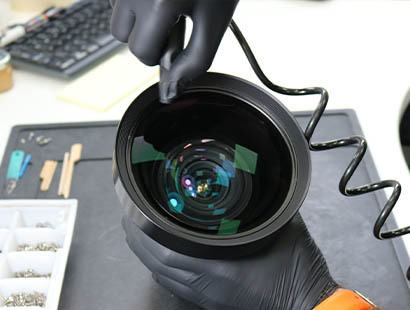
Now we’re ready to begin the assembly of the rehousing. Although our technician are highly skilled and knowledgeable, when rehousing a new range of lenses it takes a little longer to learn the characters of these. This is why we have certain technicians working on certain ranges of lenses. The more of a particular lens they work on, the more efficient they become at the process. This is another factor that enables us to keep pricing competitive. However, if they were to stop what they were used to and have to rehouse a one-off lens, it’s going to take more time. You’ll see the common theme here, if this were to become a long running range of lenses, the learning time would be diluted over the following jobs. However, for a one-off, these costs would need to be covered in the one rehousing cost.
You can learn more about the rehousing process here.
Current capacity
Now you understand all the above, but you’re still really keen to have this one special lens rehoused, it’s just got to be done no matter the cost. Unfortunately, there is one final hurdle that is likely to put a spanner in the works. That is, our current capacity. Due to the volume of our current orders and the capacity that we have, it may not be feasible to take on a one-off project at a specific time. However, it is always worth writing to us about your ideas and what you are seeking, so that we can discuss and see if we can accommodate. We are always looking to the future, and so if there is enough demand, it may well become our next project!
If you’d like to get in touch with us about your project, please get in touch with us at sales@truelens.co.uk or calling our office on +44 (0)1455 848411.